

 Deutsch
 Français
 Español
 Italiano
 Svenska
 Čeština
 Nederlands
 Русский
 Українська
 Injectable
 Oral
Oral Fat Burn
 Peptides & HGH
 SARMS
SARMS PCT
PCT Energy
 Sex Support
 Health
Bodybuilding
Peptides for Regeneration: Laboratory Comparison of BPC-157 and TB-500
Jan
In the field of sports medicine and rehabilitation, peptides have triggered a true revolution by offering targeted, molecular-level solutions for accelerating recovery processes. While not long ago injury treatment was largely symptomatic, today the focus has shifted toward activating the body’s internal tissue regeneration mechanisms.
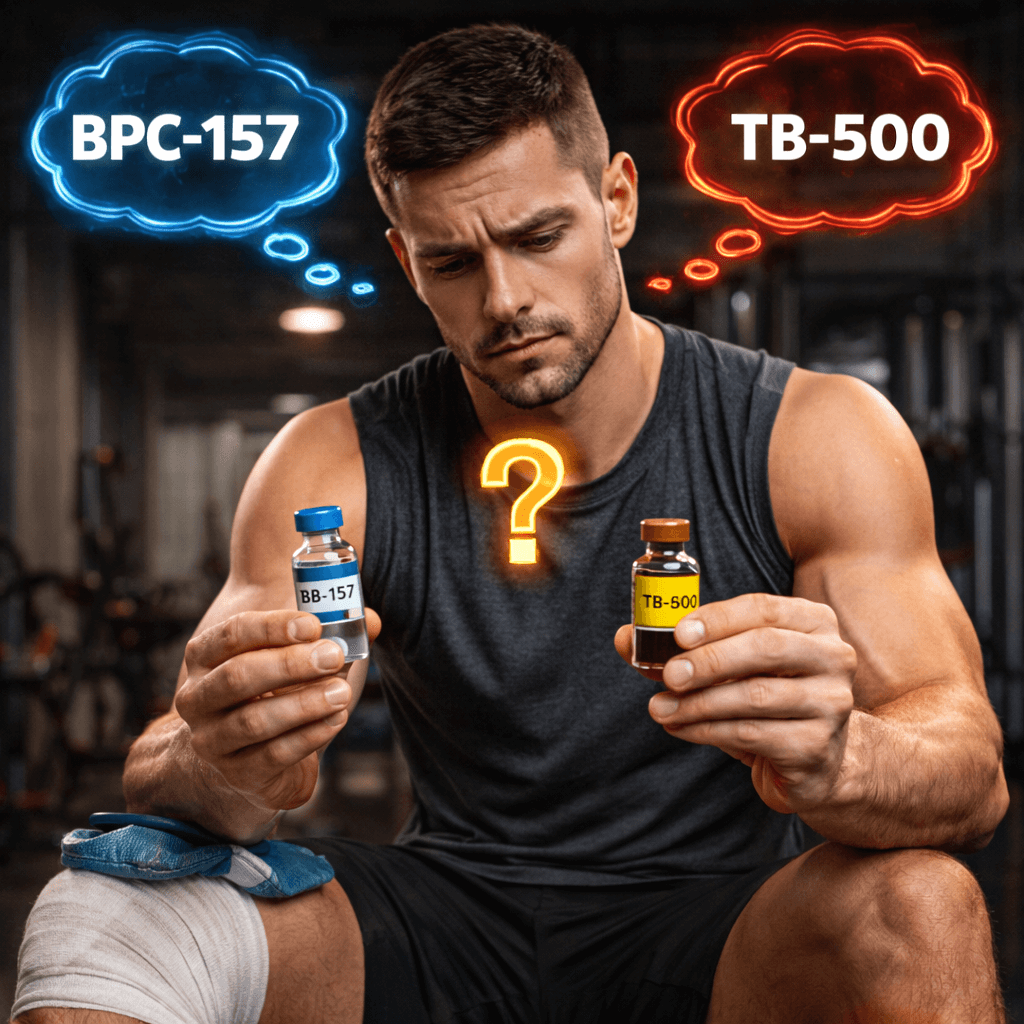
In this context, two peptides — BPC-157 and TB-500 — have become the subject of close laboratory analysis. Understanding their unique mechanisms of action is critical for building an effective recovery protocol and achieving maximum benefit. This comparison helps determine which of these powerful peptides is better suited to specific recovery goals.
Why peptides have become the primary regeneration agents: the role of BPC-157 and TB-500
Traditional pharmacology often relies on anti-inflammatory drugs that may slow down natural regenerative processes. Peptides, however, as short chains of amino acids, act as bioregulators. They mimic or enhance the body’s natural signaling pathways, which makes them indispensable in modern recovery protocols.
BPC-157 (Body Protection Compound) and TB-500 (Thymosin Beta-4) stand out among other compounds due to their proven ability to stimulate healing across a wide range of tissues. Analysis of their activity shows that these peptides can initiate the cascade of biological reactions required for rapid tissue repair.
BPC-157 gained recognition for its powerful cytoprotective effects. TB-500 attracted attention because of its role in actin regulation and cellular migration. Both peptides are effectively used to reduce downtime after injuries and significantly improve the quality of tissue regeneration.
Modern laboratory research confirms that, unlike many other agents, BPC-157 and TB-500 work both locally and systemically, creating a comprehensive recovery protocol. As a result, peptides have moved from the category of experimental supplements into the core tools of regeneration in sports medicine. Their unique properties allow athletes not just to return to training, but to do so with a minimal risk of re-injury.
Biochemical mechanism of BPC-157: effects on blood vessels, ligaments, healing, and inflammation
The unique mechanism of action of BPC-157 is based on its ability to stabilize and protect cells under conditions of stress and injury (cytoprotective effect). This peptide promotes healing by regulating the activity of multiple growth factors.
The key feature of BPC-157 is its strong angiogenic effect: it stimulates the formation of new blood vessels (angiogenesis) in damaged tissues such as tendons and ligaments. Improved blood supply ensures rapid delivery of oxygen and nutrients, which critically accelerates the recovery process.
BPC-157 also demonstrates a powerful anti-inflammatory mechanism. It modulates cytokine activity and prevents the destructive effects of free radicals. BPC-157 accelerates the healing of ligaments (such as the Achilles tendon or knee collateral ligaments) and bone defects. A structured course using this peptide supports fast and reliable restoration of tissue integrity.
In addition, the compound can counteract the toxic effects of certain medications (including NSAIDs), making it especially valuable in complex injury treatment protocols. A comprehensive analysis of its properties allows BPC-157 to be described as a “molecular bandage” for the entire body.
How TB-500 works: regulation of cell migration, tissue repair, and accelerated angiogenesis
TB-500 is a synthetic analogue of Thymosin Beta-4, a naturally occurring peptide present in virtually all human cells. Its mechanism of action differs fundamentally from BPC-157 and is focused on regeneration through cellular dynamics.
TB-500 binds to actin — a protein responsible for the cellular “skeleton” and cell movement. This interaction promotes rapid migration of cells such as fibroblasts, keratinocytes, and endothelial cells to the site of injury. This process is essential for effective tissue repair. Key aspects of TB-500 activity include:
- Migration stimulation – the peptide accelerates the influx of essential cells to the injured area, speeding up tissue regeneration and granulation tissue formation.
- Angiogenesis – similar to BPC-157, TB-500 stimulates capillary growth, but through a different pathway involving endothelial cell activation.
- Stem cell differentiation – TB-500 promotes the maturation of undifferentiated cells into specialized cells required for repair, such as muscle cells or cardiomyocytes.
Laboratory analysis shows that TB-500 is particularly effective in muscle and myocardial recovery, as actin is a key structural component of these tissues. In practice, TB-500 is often used in protocols addressing chronic injuries or recovery after extensive tissue damage. The peptide functions like a conductor, directing the movement of cellular “building materials” needed for regeneration.
Laboratory comparison of BPC-157 and TB-500: differences in mechanisms, bioavailability, and application
Comparing BPC-157 and TB-500 makes it possible to clearly distinguish their unique areas of action despite their shared regenerative effect. The key differences are summarized in the table below.
| Parameter | BPC-157 | TB-500 |
| Mechanism of action | Cell protection (cytoprotection), stabilization, VEGF-dependent angiogenesis | Actin regulation, cell migration, myocardial regeneration, non-VEGF angiogenesis |
| Main effect | Healing of tendons, ligaments, GI tract, anti-inflammatory action | Systemic muscle recovery, improved elasticity, treatment of chronic injuries |
| Application (course) | Local and systemic; more targeted action | Systemic action with full-body distribution |
| Bioavailability | High via multiple administration routes (including oral) | Most effective when injected due to larger molecular size |
The analysis indicates that BPC-157 is the ideal choice for localized recovery of a specific injury site, such as an inflamed tendon, due to its strong local cytoprotective properties. TB-500 is better suited for broader recovery protocols involving large muscle groups or chronic systemic injuries.
Laboratory data confirm that these peptides can be used synergistically. Their mechanisms complement one another: BPC-157 creates the “framework” and protection, while TB-500 delivers the “building materials” by activating cell migration. This comparison does not force a choice between the two, but rather demonstrates how combining them can maximize regenerative outcomes.
Who each peptide is suitable for: indications, goals, and course characteristics
BPC-157 is ideal for athletes dealing with clearly localized injuries. Indications include:
- tendinitis;
- ligament strains;
- cartilage tissue damage.
Course specifics: when treating tendons, injections are often administered as close as possible to the injury site to enhance local effects. Typical course duration ranges from 4 to 6 weeks.
TB-500 is used for systemic recovery and endurance enhancement. Indications include:
- extensive muscle injuries (tears);
- chronic joint pain requiring overall regenerative support;
- the need to improve flexibility.
Course specifics: the peptide is usually administered subcutaneously. Its systemic mechanism allows coverage of the entire body and is often used preventively before starting high-intensity training cycles.
Ready-made BPC-157 and TB-500 protocols from Dinespower
Ready-to-use recovery solutions featuring these peptides are available from the Dinespower online store. After a muscle tear, BPC-157 can be used to accelerate healing of damaged tissue. TB-500 is suitable for restoring overall muscle function and elasticity.
An optimal regeneration strategy may also include combined use of these peptides. The store offers a synergistic solution in the form of BPC-157 & TB-500 Mix, which combines the strengths of both compounds. This комплекс approach is ideal for treating complex and chronic injuries, providing both local and systemic regenerative support.


